
Geometry Dash Spider







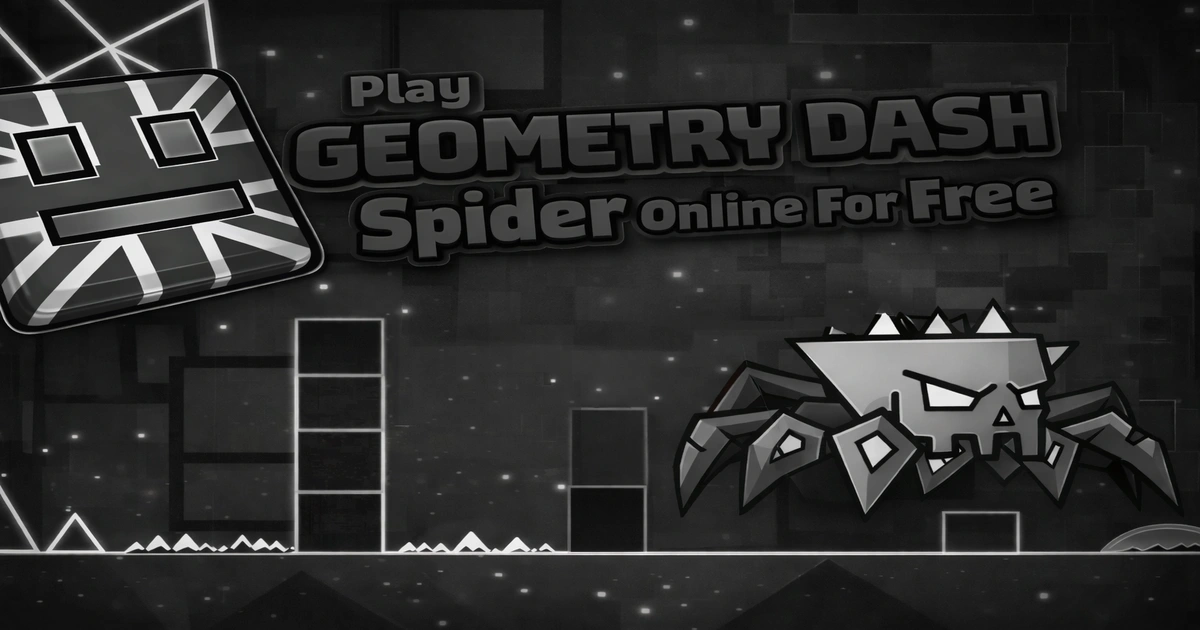
Geometry Dash Spider introduces a new physics paradigm where the Spider mode flips your position instantly between floor and ceiling, challenging players to rethink spatial reasoning beyond traditional cube-based gameplay. This Geometry Dash Spider experience redefines reflex expectations for rhythm platforming enthusiasts.
Unlike cube or ship modes, Spider eliminates safety buffers, requiring perfect timing with every click as positional inversion occurs immediately, creating unforgiving precision-based challenges for UK players.
For those seeking the ultimate rhythm-based test, Geometry Dash Spider strips away gradual learning curves, demanding split-second reactions and perfect musical rhythm synchronization in a truly intense gameplay experience.
The Spider vs The Ball: Understanding the Logic
Instant Teleportation vs Curved Gravity
The Geometry Dash Spider employs instant teleportation that flips your position between surfaces without interpolation or travel time. Click whilst on the floor and you’re immediately on the ceiling; click again and you’ve returned to the floor. This binary state system contrasts fundamentally with the Ball mode’s curved gravity inversion that creates smooth transitional arcs between surface attachments. Learn more about video game physics concepts.
Ball mode mechanics allow repositioning whilst airborne through its curved trajectory system. During the gravity arc between surfaces, you maintain directional influence and can assess upcoming obstacles whilst transitioning. This forgiving mechanic gives your brain processing time that Geometry Dash Spider’s instantaneous teleportation completely eliminates.
The cognitive differences prove substantial. Ball mode trains pattern recognition and trajectory prediction—you learn to “read” upcoming sections and plan gravity flips that position you optimally. Spider mode demands pure reaction speed and binary decision-making—you’re constantly choosing “floor or ceiling, NOW” without the contemplative luxury gradual transitions afford.
Reaction Time Requirements
The Geometry Dash Spider requires faster reaction times than any other Geometry Dash mode because teleportation mechanics compress decision windows to absolute minimums. Where cube players have 200-300 milliseconds to decide jump timing and trajectory, Spider players work within 50-100 millisecond windows between obstacle revelation and required teleportation execution.
UK gamers face particular challenges from input lag that international servers introduce. Even 30-50 milliseconds of latency—imperceptible in slower games—proves catastrophic in Geometry Dash Spider mode where timing windows already measure in fractions of seconds. This makes server location and connection quality absolutely critical rather than merely beneficial for optimal Geometry Dash Spider performance.
Neurological processing limitations become the ultimate skill ceiling in Geometry Dash Spider. Human visual reaction times average 200-250 milliseconds, meaning conscious reactive decisions often arrive too late for Spider’s demands. Mastery requires developing subconscious pattern recognition where inputs become instinctive responses to visual stimuli rather than deliberate conscious choices.
The Satisfying “Click-Clack” Rhythm
Geometry Dash Spider movement creates distinctive auditory rhythms through rapid floor-ceiling alternation that produces satisfying “click-clack” patterns synchronising with music. Successful Geometry Dash Spider navigation sounds musical—a percussion performance where your inputs form beats complementing the soundtrack rather than fighting against it.
The rhythmic element transforms Geometry Dash Spider from pure reflex challenge into musical performance. Elite players describe entering flow states where they’re not consciously clicking but rather “playing” the Spider section like a musical instrument, with inputs guided by internalised rhythm rather than visual processing.
Audio feedback importance escalates in Spider mode beyond other game types. The click-clack cadence provides timing confirmation that visual processing can’t match—your ears detect rhythm irregularities faster than your eyes spot positioning errors, making sound an essential feedback channel for performance optimisation.
Frame-Perfect Performance on UK Servers
The One-Frame Death Margin
In Spider mode, one-frame lag means guaranteed crashes because teleportation mechanics eliminate the positional buffers that forgive minor timing imprecision in other modes. When obstacles approach during the single frame your teleportation should execute, any delay—even 16.67 milliseconds at 60 FPS—positions you incorrectly for the obstacle configuration, resulting in instant collision.
Frame-perfect execution becomes literally mandatory rather than aspirational. Unlike cube sections where you might survive mistimed jumps through fortunate hitbox interactions, Spider sections demand absolute precision where every click must execute within its designated frame window. This unforgiving standard creates the brutal difficulty Spider enthusiasts embrace.
Input buffering limitations mean you cannot compensate for lag through predictive clicking. The game processes inputs frame-by-frame without queuing future commands, so clicking early for anticipated teleportation needs still executes during the wrong frame if lag delays processing. Only zero-latency connections enable the frame-perfect inputs Spider mastery requires.
Zero-Latency UK Server Excellence
GeometryDashGame.uk delivers zero-latency 60 FPS experiences through dedicated UK server infrastructure positioned for optimal British player access. Our hosting ensures inputs register within single-digit millisecond timeframes across England, Scotland, Wales, and Northern Ireland—the technical excellence Spider mode absolutely demands for fair, skill-based gameplay.
Server proximity matters enormously for Spider performance beyond other game modes. The compressed timing windows mean even the 50-100 millisecond latency differences between UK and international servers transform playable challenges into impossibly unfair obstacles. Our commitment to British hosting provides the level playing field Spider players deserve.
Consistent frame pacing through our optimised infrastructure ensures each frame delivers precisely 16.67 milliseconds at 60 FPS without the irregular frame times that create stuttering. This consistency proves essential for developing the muscle memory and rhythm recognition that Spider mastery requires—irregular frame delivery destroys timing calibration completely.
Unblocked UK Institutional Access
The game is fully unblocked for school, college, and office environments across the UK, functioning reliably through institutional content filters. We’ve configured our platform specifically for British educational and workplace networks, ensuring Spider challenges remain accessible during legitimate break times without circumvention tools that might violate acceptable use policies.
Educational appropriateness makes Spider mode excellent for demonstrating reaction time development and hand-eye coordination improvement. The abstract geometric nature contains zero inappropriate content whilst providing genuine cognitive benefits through reflexive skill development—educators can confidently allow access knowing students gain measurable benefits beyond mere entertainment.
Pro-Tips for Spider Precision: Mechanics Mastery
1. Click Intensity: Short Sharp Inputs vs Sustained Holds
Short, sharp clicks work dramatically better than sustained button holds for Spider navigation because teleportation mechanics respond to input initiation rather than duration. Holding creates no beneficial effect—the teleportation executes on click initiation regardless of how long you maintain pressure. Brief taps provide identical results whilst enabling faster subsequent inputs.
The rapid-tap technique enables higher input frequencies essential for dense Spider sections requiring quick floor-ceiling alternation. Sustained holds fatigue finger muscles faster and introduce delays between releases and subsequent presses that brief taps avoid entirely. Elite players develop staccato tapping rhythms maximising input rate without sacrificing timing precision.
Tactile feedback optimization through mechanical keyboards or responsive mice improves click precision by providing physical confirmation the instant inputs register. Mushy membrane keyboards or laggy touchpads introduce uncertainty about exact input timing that undermines the absolute precision Spider demands. Consider peripheral upgrades if serious about Spider mastery.
2. Anticipate the Ceiling: Dual-Screen Scanning
Learning to scan both screen top and bottom simultaneously represents the most challenging perceptual skill Spider mode demands. Your visual attention must split between floor and ceiling obstacle configurations, processing threats from both surfaces whilst maintaining forward motion awareness—a cognitive load exceeding what single-surface modes require.
Peripheral vision development proves essential because focal vision cannot simultaneously track floor and ceiling details. Train yourself to use central focus for immediate positioning whilst peripheral awareness monitors upcoming obstacles on the opposite surface. This split-attention skill develops through deliberate practice but eventually becomes automatic.
Pattern recognition shortcuts reduce cognitive load by chunking obstacle sequences into recognisable configurations. Instead of processing “spike on floor, gap, spike on ceiling, spike on floor” as four discrete elements, experienced players recognise “alternating spike pattern” as single gestalt requiring specific clicking rhythm. This abstraction frees mental resources for novel challenge processing.
3. The “Teleport” Timing: Clearing Narrow Gaps
Narrow gaps demand understanding teleportation hitbox mechanics where your Spider occupies space on both surfaces during the instantaneous frame transition occurs. This brief dual-surface presence means gaps slightly wider than your hitbox become passable through precisely timed teleportation that positions you optimally during the transition frame.
Gap-threading technique involves teleporting exactly when your leading edge reaches the gap’s entrance, allowing your trailing hitbox to clear the obstacle whilst your leading edge begins occupying the opposite surface. This advanced technique enables navigating obstacles that appear impossibly tight, separating elite players from competent ones.
Practice mode experimentation with frame-by-frame analysis reveals optimal teleportation timing for specific gap configurations. Use any available practice features to study exactly which frame produces successful gap clearing, then drill that specific timing until muscle memory executes it reliably during full-speed runs.
4. Rhythm Over Sight: Musical Timing Mastery
Visual processing proves too slow for optimal Geometry Dash Spider performance—conscious reaction to visible obstacles consistently arrives late given the compressed timing windows. Instead, internalise the musical rhythm completely, allowing beat synchronisation to guide teleportation timing rather than visual confirmation.
Audio cues provide earlier warning than visual detection because obstacle patterns synchronise with musical elements. Bass hits, snare patterns, and melodic phrases telegraph upcoming teleportation requirements through audio channels that your brain processes faster than complex visual scenes. Trust your ears over your eyes for superior timing.
5. Accept the Learning Curve: Failure as Education
Geometry Dash Spider mode features the steepest learning curve of any Geometry Dash mechanic—expect hundreds or thousands of attempts before achieving competence. Each crash teaches precise timing requirements for specific obstacle configurations, gradually building the comprehensive pattern library that mastery requires. Embrace failures as essential data rather than frustrating setbacks.
Progress tracking through attempt counts in Geometry Dash Spider rather than completion percentage maintains motivation during the brutal early learning phase. Celebrate reaching attempt milestones—100 attempts, 500 attempts, 1000 attempts—acknowledging that dedication itself represents achievement even before successful completion arrives.
Visuals & Aesthetics: Purple-Themed Navigation Aids
Purple-themed neon obstacles provide Spider-specific visual coding that helps identify sections requiring teleportation mechanics versus other game modes. The distinctive colour scheme creates instant recognition—”purple obstacles ahead means Spider section approaching, prepare mentally for teleportation demands.”
Colour psychology benefits from purple’s association with precision and focus in gaming contexts. The hue choice isn’t arbitrary—purple provides excellent contrast against common background colours whilst maintaining visual clarity that doesn’t fatigue eyes during extended play sessions.
Environmental storytelling through aesthetics creates thematic consistency where Spider sections feel cohesive and intentionally designed rather than arbitrarily arranged obstacles. The purple theming unifies disparate challenges into coherent experiences that feel purposeful.
Visual clarity maintenance ensures obstacles remain instantly recognisable despite decorative theming. The functional requirements of gameplay never subordinate to aesthetic ambitions—purple elements always clearly communicate danger zones requiring specific teleportation timing rather than obscuring critical gameplay information.
Browser Compatibility: Technical Excellence
HTML5 game architecture ensures universal compatibility across modern browsers without plugin dependencies that plagued earlier web gaming. The standards-compliant implementation runs identically across Chrome, Firefox, Safari, and Edge without browser-specific quirks or performance disparities.
Optimisation for Chrome and Edge on UK school Chromebooks receives particular attention given these devices’ prevalence in British education. Despite modest specifications, modern Chromebooks deliver smooth 60 FPS Spider gameplay when paired with our optimised code and UK server hosting.
WebGL acceleration leverages hardware graphics capabilities even on integrated GPUs, ensuring the visual effects and smooth animation Spider mode demands don’t compromise performance. This hardware acceleration proves essential for maintaining consistent frame rates during visually complex sections.
Responsive design adapts interface elements and control schemes across device types—desktop keyboards, laptop trackpads, and mobile touchscreens all receive optimised input handling appropriate for their physical characteristics whilst maintaining gameplay consistency.
Advanced Mechanics: Deep Technical Insights
Hitbox Behaviour During Teleportation
Understanding hitbox transitions in Geometry Dash Spider during teleportation frames provides advanced players with precise knowledge enabling seemingly impossible navigation. During the instant frame where position inverts, hitbox presence on both surfaces creates brief windows where specific obstacle configurations become passable through exact timing.
Frame-data analysis in Geometry Dash Spider reveals the single-frame opportunities where hitbox positioning allows narrow gap threading. This technical knowledge separates world-class players from merely excellent ones—understanding exact frame mechanics enables routes that appear impossible without this specialised knowledge.
Input Buffering and Queue Systems
Geometry Dash processes inputs frame-by-frame without queuing future commands, meaning predictive clicking cannot compensate for lag or anticipated obstacles. Each input executes during its specific frame rather than buffering for optimal future execution—this limitation makes connection quality absolutely critical.
The absence of input buffering creates the unforgiving precision demands that define Spider difficulty. You cannot click early and trust the game will execute teleportation at the optimal moment—timing must be exact within the designated frame window or failure becomes inevitable.
Master the Gravity with More Games
Loved the lightning-fast transitions in Geometry Dash Spider? Keep defying gravity! Explore our collection of high-speed rhythm games where every click counts. From gravity flips to precision jumps, the challenge never stops.
Gravity & Precision Challenges
Top Recommended Dash Games
Instant Teleport! Master the spider’s crawl and defy gravity. Ready for more high-speed action? Explore here:
Mechanics-Based FAQ: Technical Questions Answered
How is the Spider Different From the Cube?
The Spider employs instant teleportation between floor and ceiling surfaces without arc-based jumping mechanics. Whilst cube mode involves gravity-affected jumps with predictable trajectories, Spider mode uses binary positioning where you’re always attached to either floor or ceiling with instantaneous transitions between states. This fundamental physics difference creates entirely distinct cognitive demands and timing requirements.
Is Geometry Dash Spider Unblocked Harder Than the Original?
Spider sections in Geometry Dash Spider consistently rank among the most difficult Geometry Dash mechanics because teleportation eliminates the timing buffers that arc-based movement provides. The instantaneous gravity-flip demands faster reaction times and more precise inputs than cube, ship, or ball modes. Most players find Spider sections significantly harder than equivalent-difficulty sections using other mechanics.
Can I Play This on a Touch-Screen Device?
Yes—touch-screen compatibility in Geometry Dash Spider is excellent with optimised mobile controls. Screen taps execute teleportation inputs identically to mouse clicks or keyboard presses, providing responsive control that many players actually prefer. The simplified input scheme (single tap for all actions) translates perfectly to touchscreen interfaces without the complexity multi-button controls would introduce.
What Causes Input Lag and How Do I Fix It?
Input lag in Geometry Dash Spider stems from multiple sources: network latency to game servers, display response time, peripheral polling rates, and browser performance. Minimise lag by: using GeometryDashGame.uk’s UK servers for optimal latency, closing unnecessary browser tabs, connecting via wired Ethernet rather than Wi-Fi when possible, and using responsive peripherals with high polling rates.
How Long Does Spider Mastery Take?
Mastery timelines in Geometry Dash Spider vary enormously but expect 20-50 hours of focused practice before achieving consistent competence in Spider sections. World-class performance in Geometry Dash Spider requires hundreds of hours developing the neurological pathways that enable subconscious pattern recognition and instinctive timing. However, noticeable improvement occurs within hours as your brain adapts to teleportation mechanics.
Are There Different Spider Speeds?
Spider sections feature variable speeds through level design that adjusts forward velocity and obstacle density. Slower Spider sections allow learning fundamental mechanics, whilst high-speed variants test absolute limits of human reaction capability. The speed variations create natural difficulty progression within Spider-focused levels.
Final “Defy Gravity” Challenge!
Ready to defy gravity itself? Launch Geometry Dash Spider Unblocked right now and discover whether you possess the lightning reflexes necessary for teleportation mastery. With guaranteed unblocked access, frame-perfect 60 FPS performance, and zero-latency UK server hosting, you’re moments away from testing your absolute reaction speed limits!
Your ultimate challenge: Can you handle the Spider’s instantaneous speed? This isn’t gentle rhythm gaming with forgiving timing windows—this is brutal precision demands where single-frame mistakes mean instant death. Only the fastest, most focused players achieve Spider mastery. Do you have what it takes?
Share your best completion percentage with the UK geometry community! Whether you’ve conquered entire Spider levels or struggle to reach 10%, your progress represents genuine achievement given Spider’s notorious difficulty. Compare stats with classmates, discuss strategies for particularly brutal sections, and celebrate every percentage point gained through dedicated practice.
Whether you’re seeking rhythm games with teleportation mechanics that test absolute reaction limits, want Spider mode mechanics explained with technical precision, or simply can’t resist the challenge of Geometry Dash’s most demanding game mode, Spider delivers uncompromising difficulty without apology.
Gravity is merely a suggestion. Teleportation is your reality. Mastery awaits the dedicated!
Play Geometry Dash Spider free today and discover why UK rhythm gamers consider Spider mode the ultimate test of reflexes, timing, and mental fortitude!
Defy gravity—master teleportation! ⚡🕷️